Chris Pray

The American dream is a math problem before it's a motivation problem.

Bills paid without a knot in your stomach. One modest vacation a year. Christmas without a February hangover. Retirement with dignity. That whole list has a price tag — $120,000 to $140,000 a year — and fewer than one in four American workers earns it alone.

This book is about becoming one of them.

No crypto. No hustle-culture hype. No rented Lamborghinis.

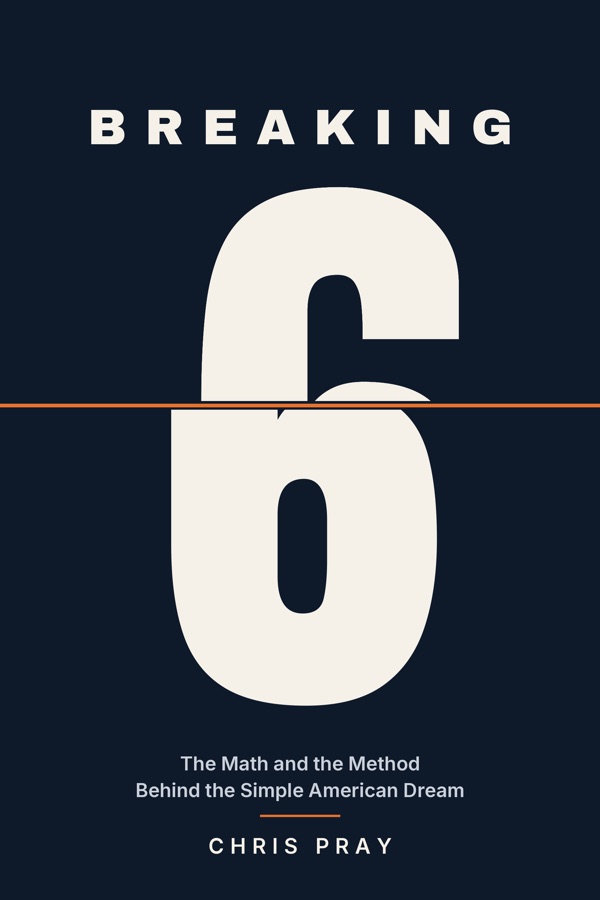
Breaking Six by Chris Pray — book cover: a large cream numeral 6 on navy, cut by a single orange line.

The sentence that started this book

$6.50

What an American family of four earning $100,000 a year has left at the end of the month — on the lean budget, with one car payment and the government's low-cost grocery plan. Before the vacation, which no longer fits. Before retirement, which doesn't exist.

Chapter 2 — What the Dream Costs


The proof

Three paychecks meet one honest budget.

Build a budget for a family of four living the simple dream — a house below the national median, two used cars, the USDA's moderate grocery plan, a week's vacation within driving distance, and 10% of income saved for retirement. Every figure is a national average from a real source. Nothing is invented. Nothing is extravagant.

Then run three real American paychecks through it and watch what happens.

Monthly budget outcomes for three income levels, family of four filing jointly.
Monthly Median worker
$64,860
Median household
$83,730
Six figures
$100,000
Take-home pay$4,775$6,057$7,093
Basic bills−$6,946−$6,946−$6,946
After the basics−$2,171−$889+$147
Modest extras−$955−$955−$955
Vacation, saved monthly−$417−$417−$417
Retirement (10% of gross)−$541−$698−$833
Bottom line−$4,083−$2,958−$2,059

Married filing jointly, two children, standard deduction, payroll tax and a typical 4% state income tax. Childcare and consumer debt are deliberately excluded — both are add-backs the book handles separately. Full sourcing in the book's Notes on Sources.

The median worker runs out of money before the groceries — not before the vacation. The median household, two paychecks deep, is still $889 short every month before a single dollar goes toward a kid's soccer season or a retirement account.

And six figures? The basics finally clear, with $147 to spare. That is what the number means: not wealth. The point where the arithmetic stops being impossible.

Run the math for your family →

The engine

Your paycheck is not a measurement. It's an opinion.

It's your employer's current opinion of your value — formed back when they hired you, based on incomplete information, and updated only when something forces the update.

I co-own an appraisal firm, so here it is in the language of my industry. A house has a market value at every moment. Then, every so often, an appraisal gets done and a number gets written down. Nobody confuses the last appraisal with the house's value — the paperwork catches up to what the market already knew.

You are the house. Your paycheck is the last appraisal. Chapter 3 — Market Value Tension

The gap between what you're worth and what you're paid creates a pressure. That tension — not your effort, not your boss's goodwill — is what actually moves your income. The whole strategy comes down to one move: renovate the house, relentlessly, until the gap gets too big to ignore.

And market value is made of four raw materials. Every one of them can be built. Not one is fixed at birth.

01

Skill

Getting good on purpose — the three-year plan, the reps, and why the middle of the pack stopped practicing years ago.

02

Special knowledge

The obstacle is the advantage. What you know that's hard to learn, and how barriers to entry become your best friend.

03

Trust

The compounding asset. The account that took years to fund, and what it buys you that nothing else can.

04

People

Relationships, influence, and reach — moving decisions you don't control, and a network that works when you aren't.


Two ladders, one frame

Climb inside an organization, or build something of your own. The playbook is the same.

The organization path

How promotion decisions actually get made

Play your role well. Map the ladder — the org chart nobody hands you. Become visible and valuable, because provided value that no one can see doesn't move a number. Plus the honest answer to "when do I jump?"

The owner's path

Starting embarrassingly small

The unfair advantages of being tiny. Moats and markets. Pricing with courage — the Jenna problem. And how to escape self-employment, which is a job you happen to own, not a business.

There's also an honest self-audit (bring a mirror), a straight answer to "the game is rigged," a chapter on what AI multiplies and what it can't — and a Field Guide of one-page tools to run the whole system.


The author

I have never appraised a house in my life.

Not one. I'm the co-owner of an appraisal firm that does millions of dollars a year in revenue, and I hold no appraisal license. I couldn't legally tell you what your house is worth. That fact carries most of the argument in this book.

I started as a $45,000-a-year staff accountant, and spent my second year with my first performance review's hard feedback printed out and pinned to my cubicle wall. I rose to corporate controller and then general manager at Woot, an Amazon subsidiary, running five of its seven product categories — a job nobody gives a controller for being good at debits and credits. Later I was a startup CFO.

In 2020 I bought into that one-man appraisal firm and rebuilt it as WP Appraisers. Here's what that glamorous entrepreneurial leap actually looked like: I kept my full-time job and worked on the firm at night, paying myself nothing. Today it has forty employees.

  • Former mayor of Paducah, Texas, and a church planter
  • Board member, Gospel Recovery Network
  • Guitarist and singer
  • Lives in Frisco, Texas with his wife Alyson and their children, Asher and Brielle
The dream is modest.
The dream is priced.
Go get it.

Breaking Six publishes soon in paperback and ebook. Join the list above and you'll be the first to know.